


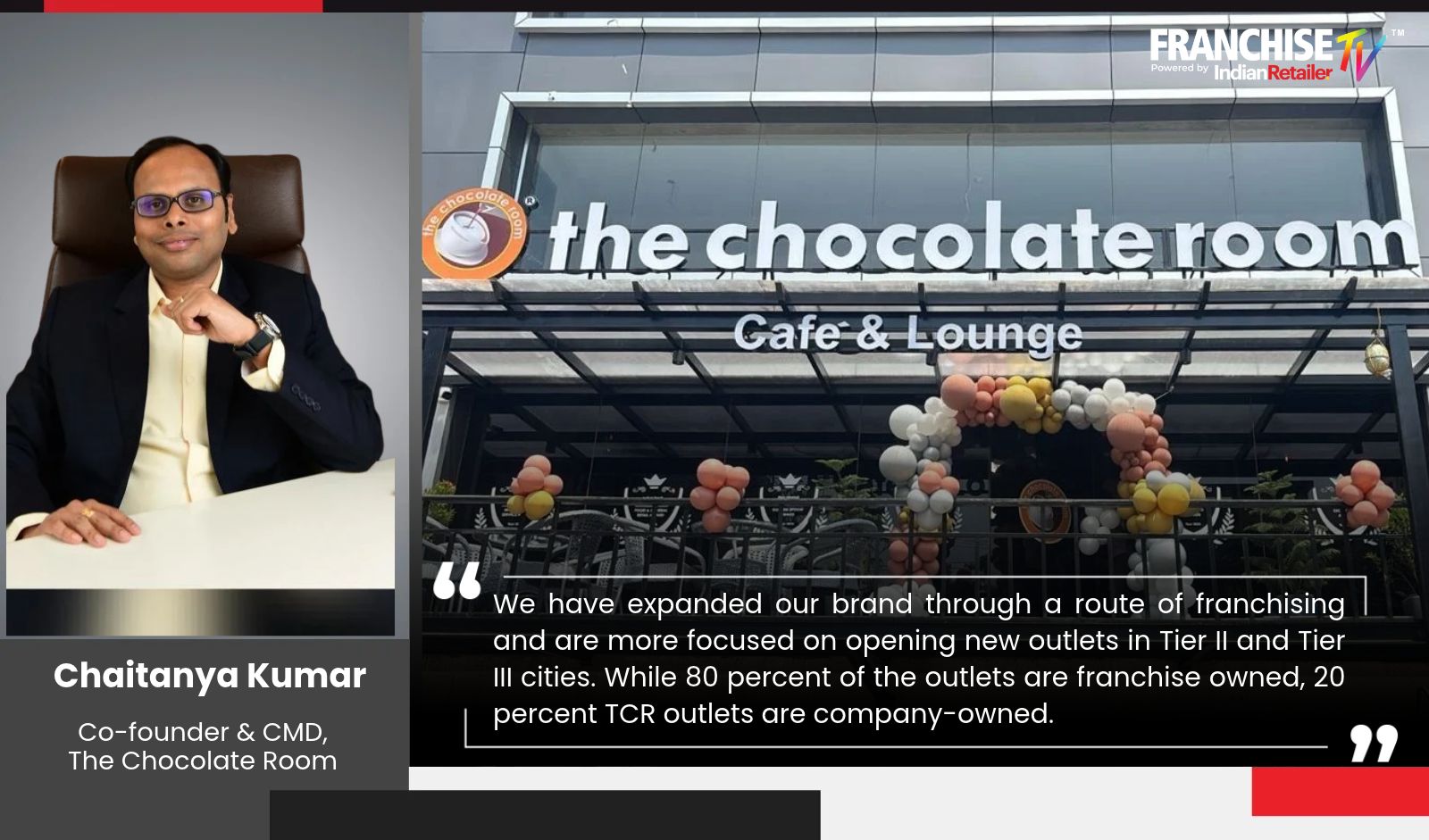
Founded in 2007, The Chocolate Room (TCR Group) is a boutique chocolate cafe that offers chocolate beverages and dessert to its customers.
‘‘We are the first to enter the Indian market as a hot and cold chocolate beverage brand. And then we boost up our menu with chocolate desserts, Mexican, Italian and Continental food and more variety of the chocolate beverages,’’ says Dr. Chaitanya Kumar Lingamallu, Co-founder & CMD, The Chocolate Room.
Brand’s Footprint in India
The boutique chocolate cafe chain has opened nearly 500 outlets in about 20 states with a strong presence in the urban cities.
Talking about the brand’s expansion strategy, Chaitanya says, ‘‘We have expanded our brand through a route of franchising and are more focused on openintsg new outle in Tier II and Tier III cities. ’’
While 80 percent of the outlets are franchise owned, 20 percent outlets of TCR are company-owned.
He adds, ‘‘We saw a lot of gap in these particular cities, while the urban cities and metros have a lot of competition…. People are looking for hangout spaces in Tier II and Tier III cities and they want to indulge in Italian and Mexican foods, as well as cafe culture. These priorities are increasing day by day in the Tier II, and Tier III cities.’’
Recent Outlet Openings
TCR has recently opened new outlets during the festive season in Tier II and Tier III cities such as Tuticorin in Tamil Nadu, Burhanpur in Madhya Pradesh and Madanapalle in Andhra Pradesh.
‘‘We are exploring new markets, covering unheard areas as there is a huge scope of expansion in these regions,’’ says Chaitanya.
Franchising Ecosystem
The brand operates the FOFO model, having 3 formats- kiosk model with a capex of INR 20-22 lakh; compact model, having an investment range of INR 50 - 60 lakh; and large standalone model.
Chaitnya shares, ‘‘We are now focusing on the large standalone models because of the growing attraction for the cafe industry. Cafes have become more than a coffee shop to a more immersive experience for the consumers. We innovate our menus and showcase ‘chocolate pouring and melting’ experience, giving a unique chocolate experiential offerings to our customers.’’
Further discussion about the brand’s franchisees in Tier II and Tier III cities, Chaitanya says, ‘‘We like working in Tier-II, and Tier-III cities because people have huge spending capacities in these regions…. People working in metro cities are gradually migrating to these cities and so we encourage our franchise partners and investors to invest in these sub-urban cities. We are identifying promoters who could expand our brands in these cities, providing them right mentoring and advice to expand our presence in these areas.’’
Challenges in the Franchising Sector
Chaitnaya says that in a franchising ecosystem, the brand has to work with different heads, which is at times challenging for the brand’s owners. Every region, be it North, South , East and West India, have their own requirements and obstacles that the brand has to overcome.
He says, ‘‘We are also learning from franchise models in other countries and adapting those models in our own country. With over 2 decades of experience, we are tuned to handle our franchise models.’’
Brand’s OmniChannel Strategy
Talking about the brand’s Omnichannel strategy, Chaitanya reveals that the brand is a little weak at digital front, but is constantly working on this domain, apart from its strong offline presence. He believes that a brand has to work 33.33% on digital and quick commerce channels respectively to grow and sustain its business.
TCR is also focusing on the drive-through/ grab-and-go model, apart from cafes to expand its business.
He says, ‘‘We at The Chocolate Room are working to spend more money on the digital side, to implement digital marketing campaigns and other modes to strengthen our presence in the country.’’
TCR’s Outlook on Foodservice Market in India
Chaitanya believes that the food service segment is an easy market entrant that has a lot of space to grow and reach maturity from investors’ side. He also sees a lot of competition in the sector and the brands have to come up with different innovations, ideas and strategies to sustain in this sector.
He says, ‘‘We need to understand it (foodservice sector) in a more detailed manner as the brands are easily entering the markets but are also vanishing fast, not being able to sustain for the long-term…. It is a hard industry and people need to research and understand this sector better before entering into it. However, this sector is going to be a multi-million industry in India in the future.’’
Future Plans
Talking about the future plans, Chaitanya says, ‘‘We plan to open new outlets and focus on small cities as well as our menu innovations. Our vision is to serve our customers with a great ambience at an economical price. We are working on expanding our presence in Tier II and Tier III cities, giving a premium cafe experience to the customers in these regions. We aim to reach 500 outlets by 2030.’’
For Further Franchise Info Contact
Explore Franchise Opportunities by Industry




Copyright © 2009 - 2026 Franchise Tv.