






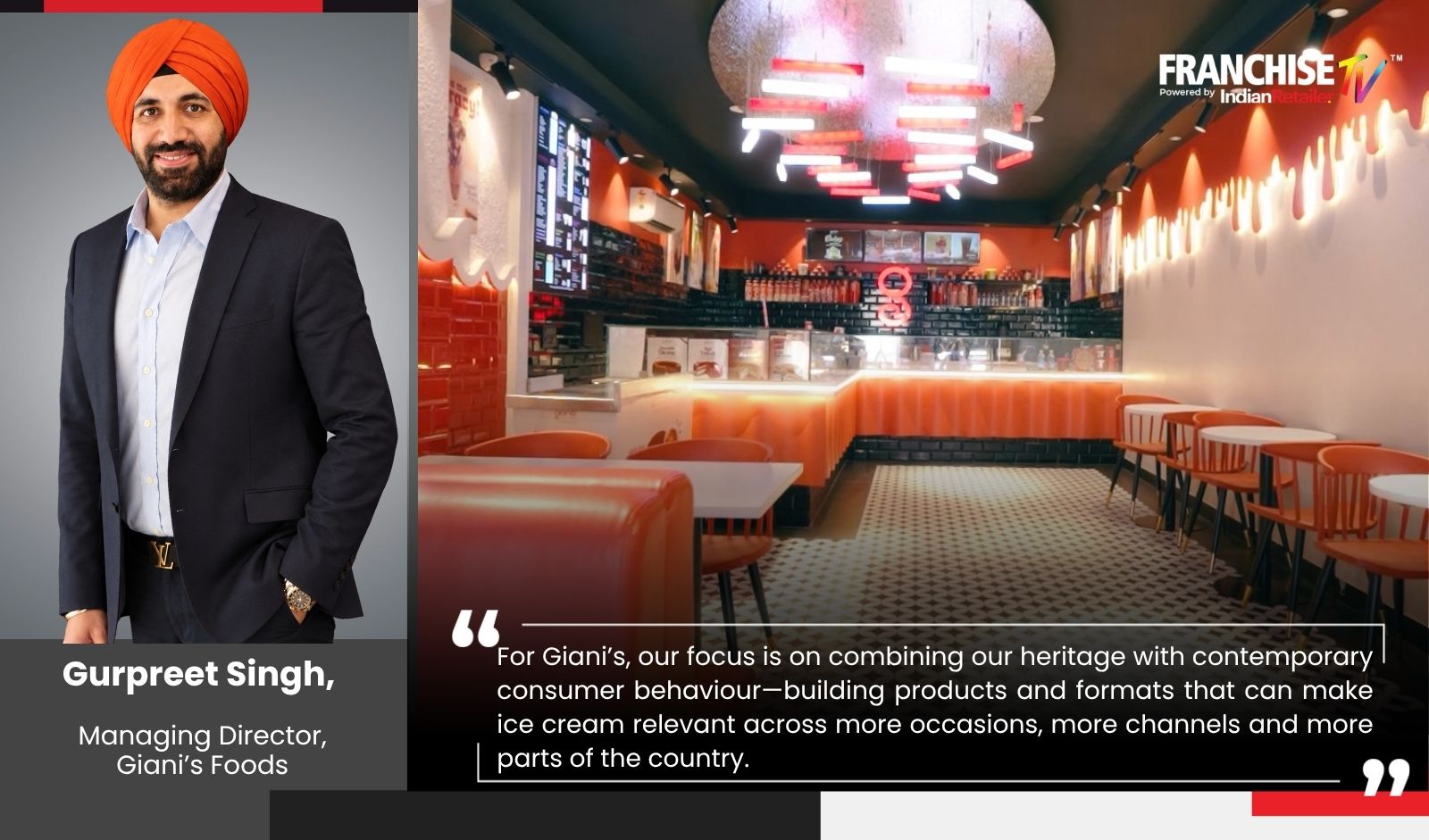
Giani’s is one of the oldest and most prominent ice cream brands, founded in 1956 by Giani Gurcharan Singh in Fatehpuri, Chandni Chowk, Delhi. Started as a small shop known as Giani-Di-Hatti selling handmade rabri-faluda, mango shakes, and traditional desi ghee halwas, the brand today has over 300 outlets across the country.
‘‘For Giani’s, our focus is on combining our heritage with contemporary consumer behaviour—building products and formats that can make ice cream relevant across more occasions, more channels and more parts of the country,’’ says Gurpreet Singh, Managing Director, Giani’s Foods.
Product Portfolio
Giani's product portfolio spans over 100 automated and traditional dessert offerings, that includes ice creams, faludas, sundaes, shakes, ice cream cakes, cassatas, kulfis, cones, and other specialities.
Retail Footprint in India
The brand has over 300 stores, with a strong presence in Delhi-NCR, Uttar Pradesh, Haryana, Punjab, West Bengal, and other regions, and has more than 200 franchise partners. The ice cream speciality brand operates primarily on a FOFO (Franchise-Owned, Franchise-Operated) business model, supplemented by a growing network of company-owned outlets.
Innovations In-Play
‘‘At Giani’s, our approach is to innovate around the consumer occasion, rather than simply launching a new flavour every time,’’ says Gurpreet. ‘‘We are working across formats such as cups, bars, sandwiches, sundaes, cakes and tubs, because each format answers a different consumer need.’’
He adds, ‘‘We are combining traditional flavours and Giani’s heritage with newer flavour combinations. For example, products such as Pistachio Kunafa, Lotus Biscoff and other contemporary dessert-inspired combinations allow us to participate in the premium and experimental end of the market while retaining our identity as a traditional Indian ice cream brand.’’
There is also considerable potential in Indian and regional flavours to take these flavours that consumers already understand and love through contemporary formats.
Gianis’ Outlook on Frozen Category in India
The frozen category in India is going through a very interesting transition. It is moving from being seen primarily as a convenience category to becoming a more regular part of the consumer basket.The category is also becoming competitive, pushing brands to improve product quality, innovation, availability and consumer experience.
‘‘From the perspective of frozen desserts and ice cream, we are seeing consumption become much less seasonal than it was traditionally. Consumers today are more willing to consume ice cream across the year and across different occasions. The growth of modern trade, quick commerce, food delivery and better cold-chain infrastructure is also making frozen products more accessible,’’ says Gurpreet.
Growth Potential in the Ice Cream and Frozen Dessert Segment
Gurpreet further shares that he sees strong potential across three broad areas.The first is single-serve and impulse formats such as cups, sticks, bars and sandwiches. These have a relatively accessible entry price and allow consumers to experiment without making a larger purchase commitment. The second is premium and indulgent formats. Consumers are increasingly willing to trade up when they see something distinctive in terms of flavour, ingredients, texture or presentation. The third is occasion-led products, such as ice cream cakes, sundaes and dessert formats. These expand the role of ice cream beyond an everyday product and make it relevant for celebrations and social occasions.
Consumption Trends
Talking about the changing consumers’ consumption trend, Gurpreet shares that the consumers are becoming much more experimental and occasion-driven.
He says, ‘‘Earlier, ice cream consumption was heavily associated with summer and family consumption. Today, we see a much wider range of occasions—individual indulgence, post-meal desserts, celebrations, impulse consumption and late-evening consumption.’’
Another important trend is the combination of premiumisation and value consciousness. Consumers are willing to spend more on something they perceive as special, but they still want accessible price points for everyday consumption.
‘‘We are also seeing smaller formats becoming increasingly important. A single-serve product can be an easy entry point for a consumer who wants to try a new flavour or format,’’ says Gurpreet.
He further shares that standardisation has become extremely important. The recipe, portion, product quality and consumer experience have to remain consistent across locations.
‘‘So our strategy is not simply more products. It is the right product, in the right format, at the right price, for the right occasion,’’ emphasizes Gurpreet. He adds, ‘‘We believe that the next phase of growth will come from increasing frequency of consumption, rather than simply increasing the number of consumers who have tried ice cream once.’’
Insights for Retailers
Further sharing insights for retailers, Gurpreet says that the biggest opportunity for retailers to stop looking at the freezer simply as a place to store frozen products and start treating it as a category that needs to be actively merchandised. Visibility matters enormously in the frozen category because consumers cannot browse the category in the same way they can browse a normal shelf. Retailers should therefore focus on freezer productivity, visibility and assortment discipline.
‘‘The right metrics are not simply how many SKUs are present, but sales per freezer, sales per square foot, stock turns, SKU productivity and incremental category contribution,’’ says Gurpreet.
Role of Quick Commerce and Food Delivery Platforms
‘‘Frozen products can work extremely well when availability and delivery speed are reliable because the purchase is often driven by an immediate consumption occasion,’’ says Gurpreet.
Quick commerce is therefore becoming an integral part of this category.Quick commerce and food-delivery platforms have made it much easier for consumers to discover products, compare prices and order an indulgence almost immediately.
Future Opportunities for the Segment
‘‘There are several ways to create excitement in frozen desserts, and flavour,’’ says Gurpreet. ‘‘At Giani’s, we have seen strong consumer interest moving beyond the conventional scoop and creating formats around a specific occasion—such as ice cream cakes for celebrations, sundaes for indulgence, bars and sandwiches for impulse consumption, and smaller cups for accessible trials. We have also seen opportunities in contemporary flavour combinations. Products inspired by desserts and global flavour trends can generate curiosity, while traditional Indian flavours provide familiarity. Pricing and pack architecture are equally important. A smaller pack at an accessible price can encourage trial, while a larger pack or premium format can increase the value of the occasion.’’
He concludes by saying that as organised retail and quick commerce continue to develop, the allocation of frozen space should increasingly be driven by consumer demand and productivity data rather than a fixed percentage benchmark. The broader opportunity is to demonstrate that frozen desserts can generate incremental purchases rather than simply taking share from another category.
For Further Franchise Info Contact




Copyright © 2009 - 2026 Franchise Tv.