






Footwear brands that sustain in India’s highly competitive and diverse market are often those that balance accessibility with evolving consumer expectations. Paragon Footwear fits this mould, known for its value-driven positioning while steadily refining its retail strategy.
Moving Beyond a Traditional Franchise Model
Paragon has recently changed its retailing strategy to some extent from an earlier franchise system approach, which was relatively passive in nature, to an involved approach.
“We have evolved from a pure FOFO model to a hybrid franchise model, giving us greater involvement in stock management, store operations, visual merchandising, customer service, and ambience. Our recently launched Paragon 2.0 format further enhances the overall retail experience,” said Nakhul Joseph, EVP - Retail, Franchise and HR, Paragon Footwear.
This approach allows the brand to retain the scalability of franchising while ensuring tighter control over how it is represented across locations.
Growth Driven by Smaller Cities
With around 70 stores, Paragon’s presence is concentrated in South India, spanning both metro cities and emerging towns. While Bengaluru, Chennai, Hyderabad, and Kochi anchor its urban footprint, the real momentum is increasingly coming from Tier II and Tier III markets.
“Cities such as Coimbatore, Goa, and several towns across Karnataka are playing a key role in driving growth,” Joseph pointed out. These channels are helping not just with the addition of more stores but also with improving the sales performance of these stores, indicating the increasing purchasing power and brand presence outside the metro cities.
“Looking ahead, we are working towards expanding our network to 200 stores by FY2030, with franchising continuing to act as a primary growth lever,” he highlighted.
Balanced Retail Network
The Paragon’s retail network is almost equally distributed between owned and franchised stores, balancing out operations and local market understanding. This 50:50 structure enables the brand to remain agile while maintaining consistency.
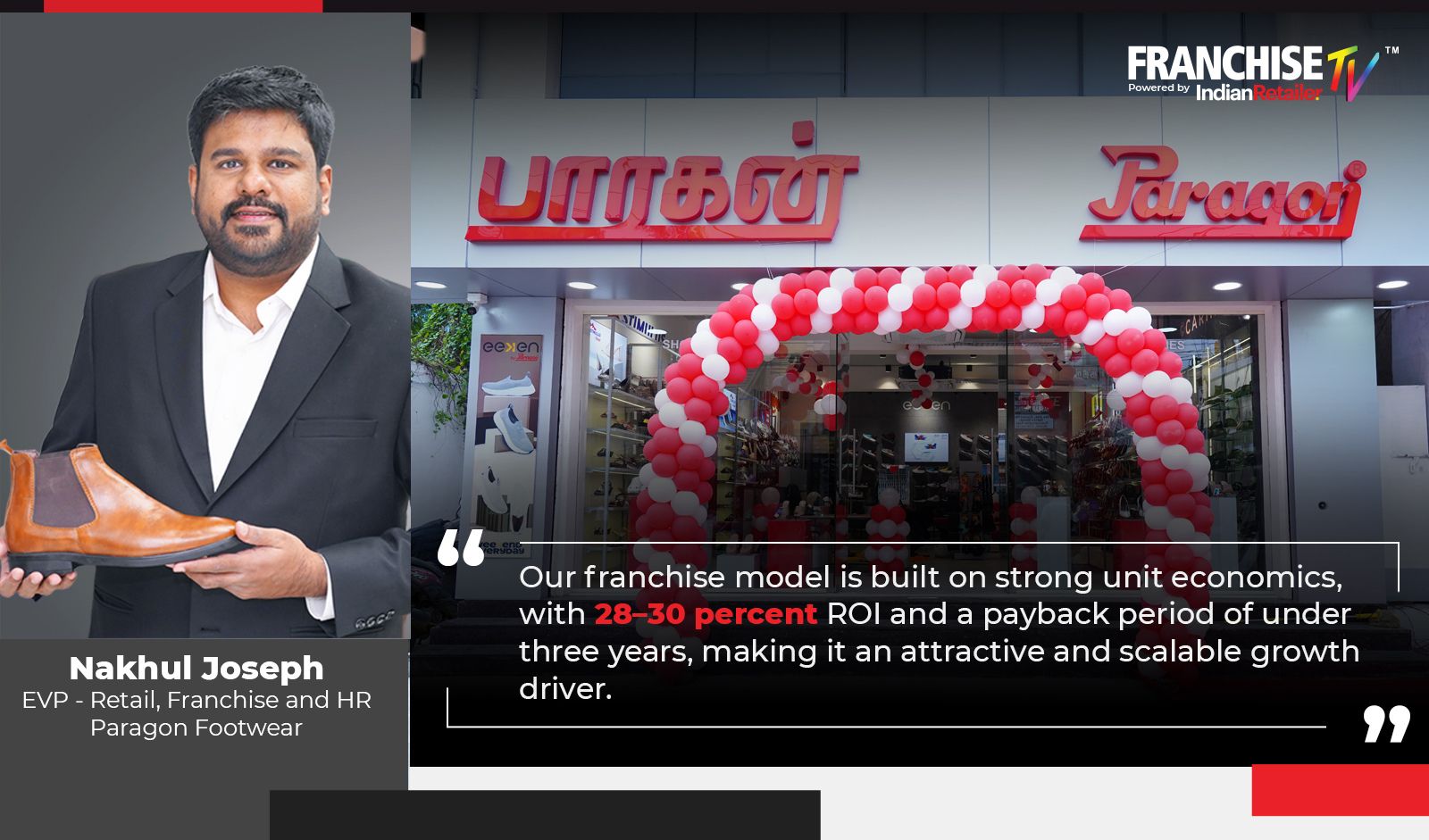
“A Paragon franchise typically requires an investment of approximately Rs 28–30 lakh, depending on the location and store size. Partners can expect an ROI of around 28–30 percent, with a payback period of 2.5–3 years,” Joseph explained.
Such economics have helped attract franchise partners, particularly in smaller markets where organised retail is still developing. The company also provides support across location analytics, supply chain, and marketing, allowing partners to focus on running day-to-day operations effectively.
Store Format and On-Ground Efficiency
The store format of Paragon is quite functional and efficient, and their store sizes range from 1,000 to 1,100 square feet. The monthly customer footfalls range from 1,500 to 1,800, indicating that there is constant demand for the product.
Regarding productivity, according to the company, the chain generates around Rs 8,500-9,000 per square foot on an annual basis. Their average price per piece is around Rs 700 in metro as well as non-metro cities.
At the same time, there is a gradual shift in consumer preferences towards slightly higher-priced categories within accessible ranges.
“Alongside Paragon, our in-house brands—Carmicci, Eeken, Pulse, Skiddo, and Stimulus—have an average selling price of around Rs 1,000 and contribute nearly 60 percent of our business, highlighting the growing demand for premium and athleisure footwear,” Joseph noted.
Loyalty Development in Value Segments
Customers that return again and again constitute a major share of Paragon’s customer base, contributing about 60 percent of total sales. This is due to the strength of their brand and stable product expectations.
Paragon keeps the relationship alive with periodic renewals of products every three to four months as well as improved in-store formats. Even within a value-driven segment, these incremental changes help sustain engagement and relevance.
“At the same time, we are preparing to strengthen our digital presence and are in the process of launching an omnichannel platform aimed at integrating online and offline retail more seamlessly,” Joseph added.
Expansion Challenges
Despite growing and overcoming various challenges, Paragon is still facing some issues in terms of managing expansion. Even in smaller cities, demand for well-located stores remains high.
“Rentals continue to be one of the biggest challenges, even across Tier II and Tier III markets, as 1,000 sq. ft. retail spaces remain highly sought after while supporting our preferred store format,” Joseph pointed out.
This makes cost management a critical factor as the company balances expansion with maintaining store efficiency and customer experience.
Retail Experience in Stages
The growth history of Paragon Footwear does not involve sudden changes but rather a series of adjustments made to cope with changing dynamics of the market environment. With the help of improving the franchise concept, expanding into smaller cities, and meeting new demands from the customers, Paragon continues to consolidate its established place in the market.
Within a highly dynamic and competitive retail landscape, such an approach helps the company to stay on the ground while slowly transitioning to a more contemporary retail format.
Facts:
- Current store count – 70 stores
- Franchise vs COCO – 50:50 split
- Expansion timeline – 200 by FY2030
- Top markets – Chennai, Bengaluru, Cochin
- Franchise investment – Rs 28–30 lakh
- ROI period – 2.5–3 years
- Price range – Rs 1,000–2,000
- Store size – 1,000 sq ft
- Growth category – Women Comfort EVA
- Key challenge – High rentals
For Further Franchise Info Contact






Copyright © 2009 - 2026 Franchise Tv.