





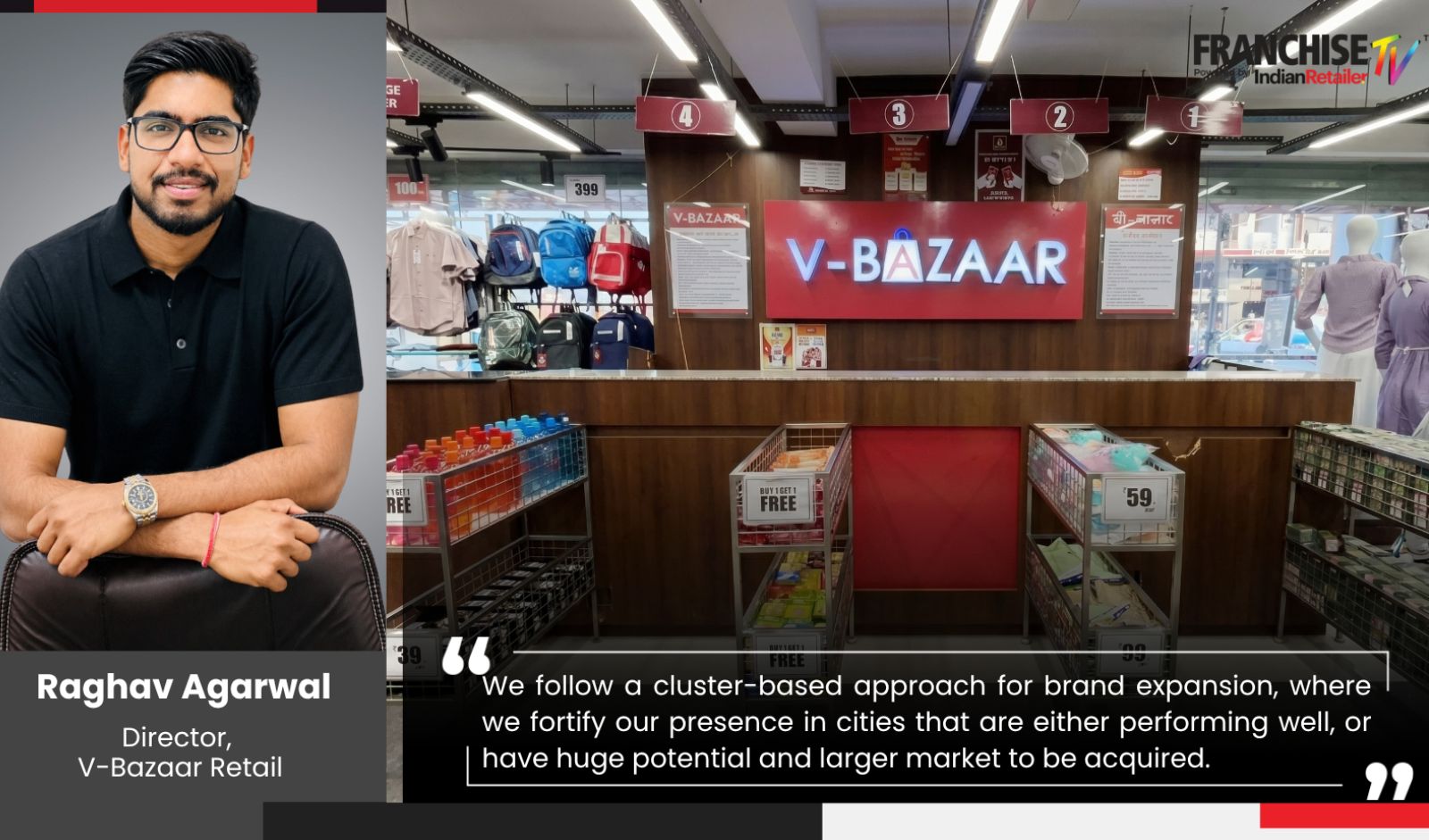
V-Bazaar is a value-for-fashion retailer brand launched in 2016 by Hemant Agarwal. The brand opened its first store in Lakhisarai, Bihar. Today the brand has expanded to 126 stores, operating in 6 states and 89 cities.
‘‘V-Bazaar sells high-quality, affordable fashion and lifestyle products that cater to the everyday needs of Indian families. Our brand motto is ‘Daam Kam Fashion Hardam ’’’, says Raghav Agarwal, Director, V-Bazaar Retail.
Product Mix at V-Bazaar
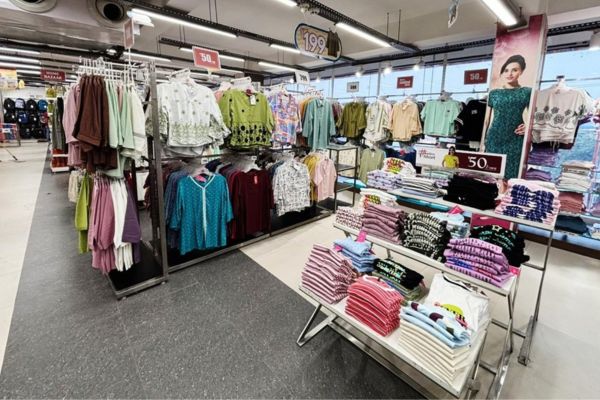
The retail brand has an extensive portfolio of retail goods and a wide range of product categories that serve family requirements. V-bazaar deals in fashion apparel and accessories, general merchandising and home provisions.
Talking about the product mix and its sales percentage, Raghav shares, ‘‘We are catering to the fashion needs, as well as general merchandising and home provision segment. Our sales mix consists of 75% fashion apparels, 18% general merchandising that includes home furnishings and the remaining 7% is from the home provision segment.’’
New Store Openings and Brand Expansion Strategy
Raghav reveals that V-Bazaar has recently opened new stores in UP, Bihar and Chhattisgarh, with Chattisgarh being a new market entry point for the brand. The company plans to open 15 stores this year.
Discussing his brand expansion strategy, Raghav says, ‘‘We follow a cluster-based approach for brand expansion, where we fortify our presence in cities that are either performing well, or have huge potential and larger market to be acquired.’’
He further shares that V-Bazaar aims to take more customers under its belt, and plans to open new stores in cities nearby to its existing store locations for better supply chain management and logistics.
Brand’s USP
Talking about the brand’s USP, Raghav shares, ‘‘Our main USP is our private labels, and premium quality products, followed by exceptional customer experience and honest pricing model, which will definitely separate us from the rest of the brands. Our affordable product range with lesser markups as compared to the other retail players is a major differentiating factor for us in this sector.’’
Role of Franchising in Fashion Retail Sector
Further discussing the role of franchising in the retail segment, Raghav says, ‘‘Franchising is taking the legal rights to operate under other’s brand identity. There are a lot of business models that work on franchise models including the fashion retail sector. From the business standpoint, the franchise model can be very good for this sector as it helps the retailer to expand its footprint and hyperscale without having to invest in large capex right away. However, if it is not managed well by the franchisee, they can end up gambling with the brand image.’’
Omni Channel Strategy
Raghav shares that the brand currently does not have e-commerce presence, and solely relies on the brick and mortar concept.
He says, ‘‘We believe that in fashion retail still depends on the touch and feel concept for the customers before making a purchase decision. Moreover, the fashion sector is more driven on product variety, store ambience, and immediate access to product purchase.’’
However, he also believes that one cannot completely turn his/her back on digital presence in the retail sector. He reveals that the company plans to venture into e-commerce and expand its e-commerce operations. The company will focus on omni-channel strategy to cater to online demand, using its existing stores as my fulfillment center.
‘‘As a part of our upcoming e-commerce rollout plan, we will cater to the online demand through our own app which will be driven by our own own team for immediate size level requirement. We plan to call it ‘the Endless Aisle concept’ where we cater to the size level needs or design demands at a store level. And eventually, we will have our own online platform to meet our online demands,’’ says Raghav.
Raghav further shares that the brand will launch the endless aisle concept in the next 6 months and aims to have an end-to-end integrated Omnichannel platform by introducing its own website by FY2029.
Fashion Retail Sector in India
According to a market report, the Indian fashion retail market is valued at USD 60.12 billion in 2024, and is expected to reach USD 124.32 billion by 2030, rising at a CAGR of 12.87%.
The segment is rapidly growing due to increasing disposable income, urbanization, and changing consumer preferences. With a large segment of young population and rising interest in branded apparel are further contributing to the market's growth. The rise of e-commerce platforms and omnichannel strategies by traditional retailers is reshaping the market dynamics, leading to the growing demand for ethnic wear, fast fashion, and luxury brands.
Discussing about the fashion retail segment, Raghav says, ‘‘The value fashion segment is growing at a double digit, at about 12-13 %.’’ He further shares, ‘‘We started calling ourselves more of a fast fashion retailer because today’s consumers want to be more up-to-date with fashion trends, as it is changing rapidly. Earlier the fashion trends took at least one year to evolve. Now the gap is reduced to six months.’’
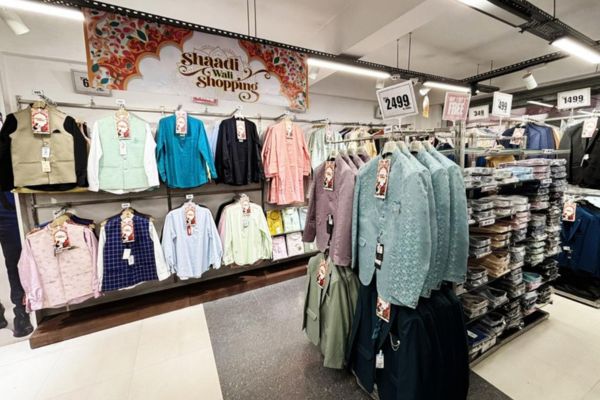
He says, ‘‘We're also trying to focus and pivot as per the market demand. Overall, I believe that every category- be it ethnic, casual, or formal wear has been doing well.’’
He further shares that the sector is witnessing an increasing demand trends from the Gen-Zs as their disposable income spending is more comparatively to other demographics segments. Festive and wedding seasons are also generating strong ethnic wear demands at the country level, due to increase in wedding spendings year-on-year. The sector is also seeing a good demand for casual wear.
Quality Control, Premiumization and Private Labels in the Fashion Retail
Sharing about the demands for premium apparels in India, Raghav says, ‘‘To cater to the premiumization demands, we have our own private labels having a variety of own designs.’’
He shares that the private labels help V-Bazaar monitor its quality on a more detailed level and experiment designs, prints, patterns on different fabrics, adding to the premiumization aspect.
He says that V-Bazaar has robust internal QC protocols and has started deep diving into the fabric level to test for every garment that we procure. Moreover, the brand is on-track with its shipments status, ensures detailed checking and timely dispatch of the garments to the customers for seamless customer experience.
Road Ahead
Raghav further reveals the long-term future plans of the company.
‘‘By the end of the financial year 2029-30, we are looking to touch INR 2000 crore in turnover and would be adding 150 stores to our existing retail chain, says Raghav. He further reveals, ‘‘We will be focused on the fashion segment, but will also explore new formats such as launching full-fledged FMCG and groceries store formats. If it does well, we may expand the new format as well.’’
Finally, he reveals that the company is already in discussion to acquire a fashion retail company and hopes to close the deal by the end of this year.
For Further Franchise Info Contact




Copyright © 2009 - 2026 Franchise Tv.